Gradual erosion of Christian presence in post-war Syria
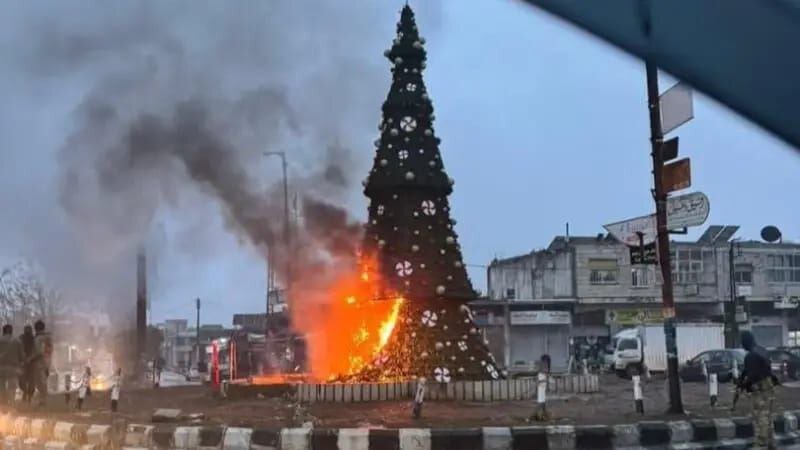
BEIRUT—In the aftermath of Syria’s prolonged conflict, the question facing the country’s Christian communities is no longer one of political alignment, but of survival itself.
Once embedded in the social, cultural, and urban fabric of Syrian life, Christians now confront a reality defined by insecurity, demographic decline, and the collapse of long-standing social guarantees.
Their predicament reflects broader transformations in post-war Syria, where power has shifted from centralized authoritarian control to fragmented systems of rule marked by ideological uncertainty and coercive governance.
For decades, Syrian Christians lived under a fragile arrangement of protection tied to the authoritarian but nominally secular state.
While this arrangement was never rooted in genuine equality, it provided a degree of stability.
Fourteen years of imposed war on the country dismantled that framework entirely. The collapse of centralized authority, followed by the ascendancy of Hayat Tahrir al-Sham (HTS) and its leader Ahmad al-Sharaa, marked a decisive rupture.
What replaced the old order was not security, but a system of conditional tolerance governed by ideological ambiguity and coercive control.
The sharp increase in asylum requests from Syrian Christians abroad reflects this reality.
Once constituting roughly ten percent of Syria’s population, Christians have seen their numbers decline at an accelerating pace.
Entire neighborhoods in Aleppo, Homs, and Damascus were emptied during the war, churches were destroyed or damaged, and families were displaced internally or forced into exile.
While the initial wave of migration was driven by the brutality of open warfare, the current exodus is propelled by sustained insecurity and the erosion of social guarantees.
Following the fall of the Assad government in late 2024, HTS attempted to rebrand itself as a governing authority capable of protecting minorities.
These efforts, however, quickly proved superficial. Symbolic gestures were contradicted by realities on the ground: social restrictions, surveillance, intimidation, and targeted pressure on Christian religious and civic life.
Governance increasingly relied on subtle coercion—moral policing, threats, and institutional exclusion—mechanisms that proved equally effective in compelling compliance or flight.
This atmosphere was further destabilized by episodes of extreme violence against other minorities, particularly Alawites and Druze, which reinforced Christian fears of being next in line.
The emergence of blurred boundaries between HTS security structures and extremist networks intensified perceptions of vulnerability.
Attacks attributed to external actors were repeatedly linked to individuals embedded within official security institutions, eroding any remaining confidence in state protection.
Beyond physical violence, everyday life for Christians has become increasingly constrained.
Religious expression is monitored, workplaces have become sites of discrimination, and schools are no longer perceived as safe environments.
Kidnappings for ransom have re-emerged as a tactic, exploiting the community’s relative economic vulnerability and lack of armed protection.
These pressures function cumulatively, encouraging departure without the need for formal expulsion.
International actors have responded selectively, often prioritizing counterterrorism cooperation and regional stability over minority protection.
For Syrian Christians, this has reinforced the perception that their suffering is instrumentalized rhetorically but rarely addressed substantively.
Diplomatic engagement with new authorities in Damascus has focused on security assurances rather than enforceable safeguards for vulnerable communities.
The result is not a sudden eradication, but a slow dismantling of an ancient presence.
Syria’s Christians now face a stark dilemma: remain under conditions of insecurity and marginalization, or leave behind a homeland their communities helped shape for centuries.
Each decision to stay has become an act of quiet resistance, preserving memory and identity amid a landscape increasingly hostile to pluralism.
Leave a Comment